
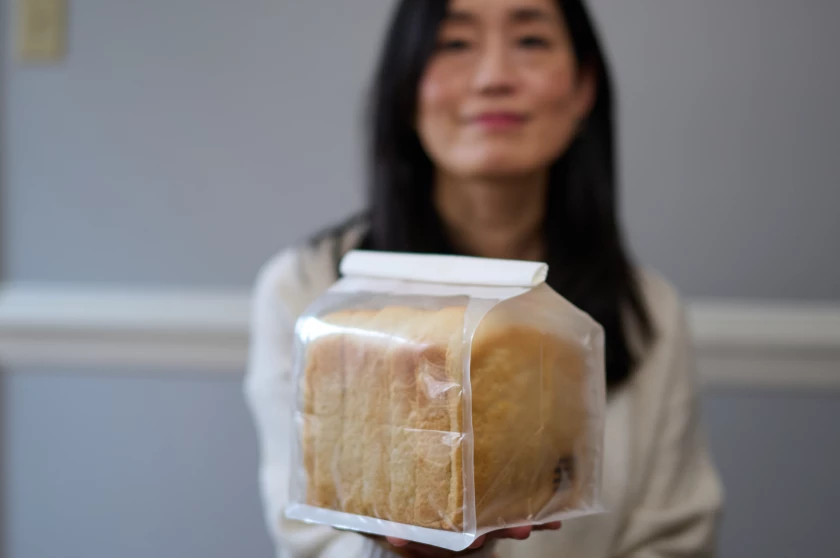
Almost every weekend, Cary resident Yukie Segnini sets up the Yukiya Bakery booth at a farmers market or festival in Wake County. She often displays several sweet breads with different flavors and fillings, as well as her most well-known product, Japanese milk bread.
"Japanese bread is very fluffy, very soft," Segnini said. "It has a chewy texture and a rich flavor because of the milk."
Milk bread, also known as shokupan, can be found in many bakeries in Japan. But outside of Asia, the product is more difficult to find, which is why Segnini started her bakery.
The presence of Asian bakeries in the Triangle has grown significantly in recent years. In the late 1990s, Grand Asia at Cary's South Hills Mall was one of the few places that sold Asian pastries, like pineapple and roast pork buns. Now, the number of Asian cafes has gone up exponentially, especially in Cary, where Asians make up more than 20% of the town's population. Popular spots include the Taiwanese-style Brecotea, as well as the global Korean brands Tous Les Jours and Paris Baguette, which have locations in Cary and Raleigh.


Shokupan has a special history
While some stores carry loaves of fluffy, Asian-style milk breads, Yukiya Bakery, which operates as a pop-up, is the only one in the Triangle that serves authentic shokupan.
Shokupan is typically baked in a rectangular Pullman loaf pan. To give the bread its iconic softness, Japanese bakers often use the yudane method by mixing bread flour and hot boiling water to gelatinize the starch. There's also the nakadane method, in which flour, yeast, water and sugar are combined to make a sponge — the sponge is allowed to ferment and then are added to the remaining ingredients.
Segnini noted she's used both methods and that her version of shokupan is especially fluffy. "I only use milk for my dough instead of water," she said.
Japanese milk bread's history dates back to just after the end of World War II. As journalist Clarissa Wei reported for "Proof," America's Test Kitchen podcast, the U.S. government exported massive amounts of wheat to Japan, Taiwan and other Asian countries to address the large surplus in wheat supply and to counter post-war food shortages in parts of Asia. During the Hoover administration, milk was also introduced in Japanese school lunches to address malnutrition. As wheat and powdered milk became staples of the Japanese diet, it led to a major boom in bakeries there, as well as the development of shokupan.
Sharing her passion for Japanese bread
Segnini's journey into baking began when she was a high school student, working at a small bakery in her hometown in Japan.
"I really wanted to make bread on my own, so after that, I learned how to make Japanese bread," said Segnini, 48. "I wanted to share my passion with many people."
Before moving to North Carolina in 2021, Segnini and her husband lived in a town near Munich, Germany for about five years. Missing the taste of milk bread, she decided to start selling her baked goods and found that both Japanese and German patrons enjoyed milk bread, which motivated her to take baking more seriously.


A year after moving to North Carolina, Segnini and her husband Rod Segnini started Yukiya Bakery at local farmers markets. The name Yukiya is the combination of Yukie's name and "ya," the Japanese word for home. In an email, the couple noted, "We're simply saying, come to Yukie's home."
The business grew enough that in 2023 they launched an online store that delivers her products across the Triangle. She also earned certificates at Wake Tech Community College's Bakery and Pastry Arts program, and has won baking awards from the American Culinary Federation.
To prepare for farmers markets and other events, she often bakes up to 40 loaves of shokupan a day at a commissary kitchen, and usually eight of those loaves will be used to make their sandwich products. Yukie Segnini bakes the entire inventory herself, while Rod Segnini helps with coordinating logistics.
" It's her passion, and so she could bake nonstop — even skipping sleep," he said. "So I am the one that says it's time to sleep."
Yukie Segnini's favorite bakery item is an-pan, which is a soft, red bean-filled sweet pastry. The pastry also has a long history in Japan, created by a former samurai in the late 1800s.
"I want people to eat an-pan first, and I want them to taste the authentic Japanese flavor," she said.
The couple says that Yukiya Bakery has been a great way to connect with many people in their community.

"They ask me many questions about the ingredients, the traditions, the story behind this product," said Yukie Segnini. "Some people miss Japanese food, people who've been to Japan, and so they want to try my bread. After eating, they smile always."
Yukiya Bakery currently rotates between the Apex, Cary and Western Wake farmers markets, and in 2026, they will also be appearing at South Durham Farmers Market. You can find their schedule here, and they also have products available at Java Jive in Cary.
Ways to enjoy Japanese milk bread
While shokupan has enough flavor to be eaten on its own, Yukie Segnini likes to eat the bread simply with butter. But here are some ways to level it up:
- Makes a sandwich using a spread of Japanese Kewpie mayonnaise and thin slices of cucumber
- Chop it up to make french toast
- Make fruit sandos – using whipped cream and sliced fruit
- Make meat floss sandwiches, like many Chinese diaspora folks. Also called rou song, meat floss is a flaky, cotton-like dried product usually made from pork or fish. As shown in this video, you can spread a layer of Kewpie mayo on the bread and add meat floss to make a simple sandwich.
We're interested in hearing food and culture stories that highlight the Triangle's diverse communities. Reach out to digital producer Eli Chen to share yours at elichen@wunc.org or on instagram @elichenreports.


